
OPTİMA AZERBAIJAN
iiko Official Partner
200520-1
+994 12 310 26 27
+994 50 380 88 24
Request a call back

Google continues to expand its artificial intelligence portfolio with the launch of Gemini 3.7 Flash. The new model is optimized for coding, web development, complex workflow automation, and the development of AI agents.
On August 13, 2026, Google introduced Gemini 3.7 Flash, the latest addition to the Gemini model family. The company describes it as one of its most capable Flash models to date and positions it as a strong workhorse model for coding and agent-based AI workflows.
Gemini 3.7 Flash was released only three weeks after Gemini 3.6 Flash. According to Google, the improvements are based on developer feedback and updates to the model’s core capabilities. The new version delivers stronger performance in software engineering, knowledge-intensive tasks, web development, and agentic workflows.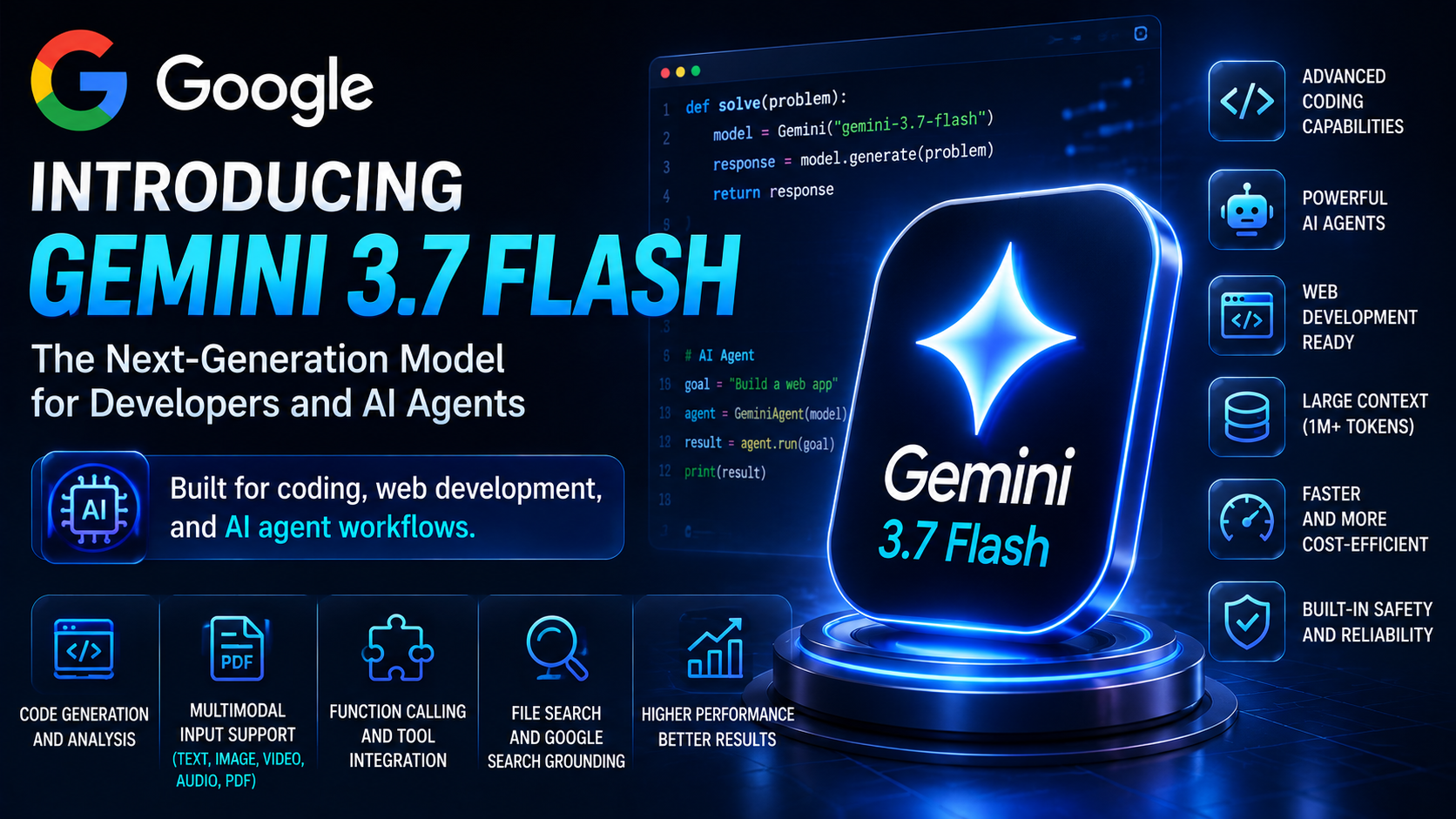
One of the key areas of focus for the new model is software development.
Gemini 3.7 Flash is designed not only to generate code, but also to analyze existing codebases, identify errors, solve programming problems, and handle longer and more complex software engineering tasks.
According to benchmark results published by Google, Gemini 3.7 Flash achieved a score of 43.6% on the FrontierCode 1.1 Main benchmark, compared with 34.4% for Gemini 3.6 Flash.
On DeepSWE v1.1, which measures long-horizon software engineering performance, the model improved from 48.6% to 65.3%.
These results indicate a significant improvement in the model’s ability to work with complex development tasks.
Another important focus of Gemini 3.7 Flash is the development of AI agents.
Unlike a traditional chatbot, which mainly responds to user questions, an AI agent can receive a goal, plan the necessary steps, use external tools, and execute a sequence of actions to complete a task.
For example, an AI agent in a business environment could:
Google positions Gemini 3.7 Flash as a more effective model for companies and developers that want to build these types of multi-step, agent-based workflows.
Gemini 3.7 Flash has also been improved in the area of web development.
According to Google, the model can create more complete and functional interfaces with fewer prompts and can better understand design references, screenshots, and existing design systems.
The model can also assist developers in turning visual concepts into usable web interfaces more efficiently.
In the WebDev Arena benchmark, Gemini 3.7 Flash achieved an Elo score of 1588, compared with 1538 for Gemini 3.6 Flash.
This improvement could be especially valuable for frontend developers, UI/UX teams, and companies that rely on rapid prototyping.
Gemini 3.7 Flash is not limited to text-based interactions.
According to Google’s official technical documentation, the model can accept several input formats, including:
This multimodal capability expands the range of possible business use cases.
For example, users can upload a large PDF report and ask the model to analyze it, extract insights from an image, interpret video content, or process different data formats within the same workflow.
The model supports an input context window of 1,048,576 tokens and a maximum output of 65,536 tokens.
This large context capacity makes it easier to work with long documents, large datasets, and complex codebases.
Gemini 3.7 Flash also supports Google’s configurable reasoning system, commonly referred to as “thinking.”
Developers can control how much computational reasoning the model uses for a task by selecting different levels such as:
This provides an important advantage.
For simple tasks, companies can choose faster and more cost-efficient processing. For more complex problems, they can allow the model to use additional reasoning resources.
As a result, organizations can balance speed, cost, and output quality depending on the specific use case.
Gemini 3.7 Flash also supports a range of advanced capabilities designed to connect AI models with external systems.
These include:
Google is also providing a preview version of its computer use functionality.
These capabilities allow Gemini 3.7 Flash to function as more than a conversational AI system.
For example, an AI agent could retrieve data from an internal company database, communicate with another platform through an API, analyze the response, and then automatically decide what action should be taken next.
This type of integration is becoming increasingly important as businesses move toward end-to-end AI automation.
Pricing is another notable aspect of the Gemini 3.7 Flash launch.
Google says the model is initially offered at approximately half the starting price of Gemini 3.6 Flash.
According to Google’s official model information, pricing is set at approximately $0.75 per one million input tokens and $3.75 per one million output tokens.
This pricing strategy may be particularly attractive for organizations that process large volumes of AI requests, SaaS companies, and development teams building AI-powered applications.
As generative AI adoption grows, companies are increasingly evaluating not only the intelligence of a model, but also the cost of running it at scale.
The launch of Gemini 3.7 Flash reflects a broader shift taking place across the AI industry.
Artificial intelligence models are no longer being developed solely to generate text or answer questions.
The next generation of AI systems is increasingly focused on performing real-world tasks and managing business processes.
In the near future, models such as Gemini 3.7 Flash could play a larger role in areas such as:
software development, quality assurance, data analysis, document processing, technical support, report generation, marketing operations, internal business processes, and automated platform management.
The development of models like Gemini 3.7 Flash also shows that competition in the AI market is no longer based only on creating the “smartest” model.
The industry is increasingly moving toward AI systems that are faster, more cost-effective, easier to integrate, and capable of completing tasks independently.
02-Sep-2026 73
You can get advice, clarify prices and order a solution from the specialists of iiko BUSINESS PARTNER AZERBAIJAN. Contact us by phone, e-mail or request a call back.