
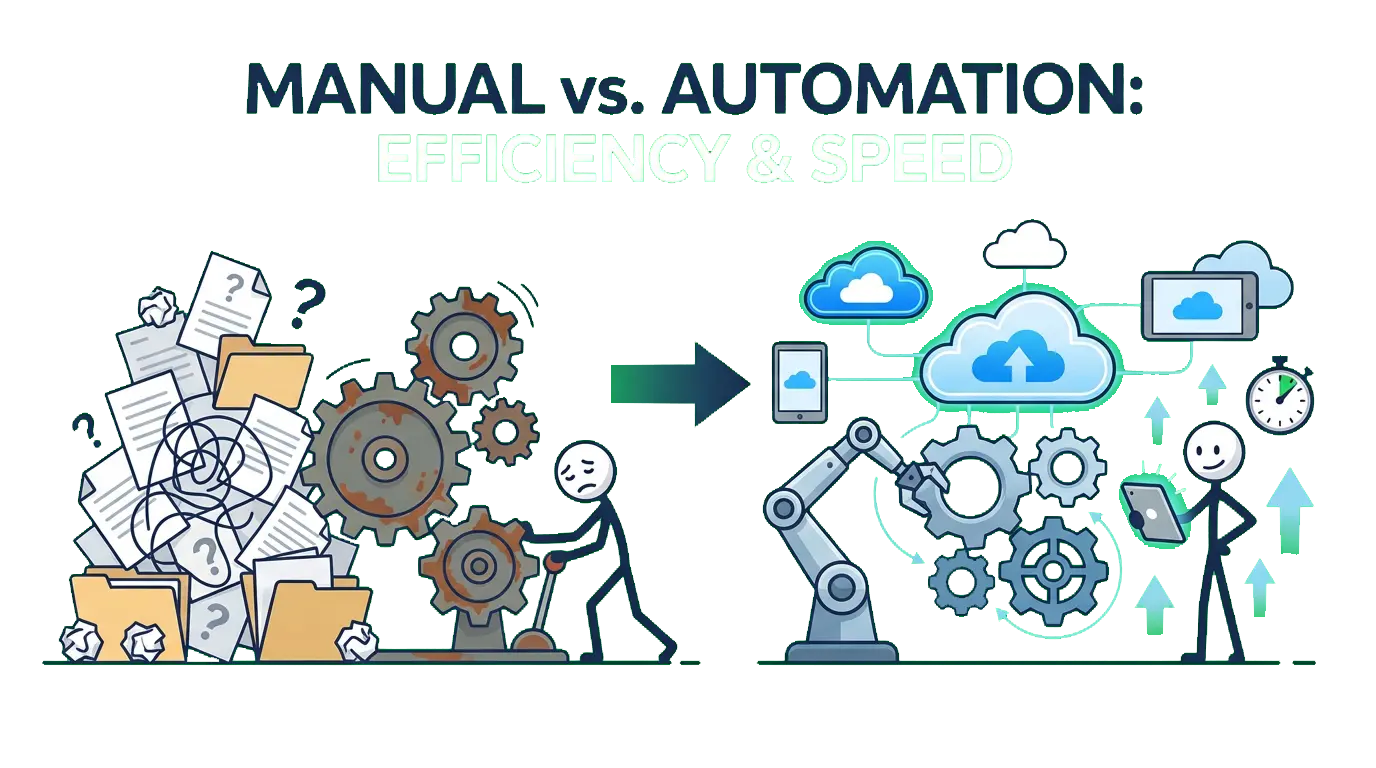
How Do Manual Processes Slow Down Business? How Does 1C Help Your Business?
In today’s business world, speed is as valuable as currency. Yet many companies remain trapped in a swamp of “Excel spreadsheets,” paper records, and endless handwritten workflows (manual processes). Manually recording orders, estimating inventory by sight, or preparing financial reports over several days are the “hidden enemies” that consume a business from within. It is precisely at this point that automation—especially 1C systems, which have become the regional standard—comes to the rescue. This software does not merely add up numbers; it transforms chaos into a system.

The Hidden Dangers of Manual Processes
At first glance, manual management may seem inexpensive and simple, but over time it delivers serious blows to a business. These risks can be grouped as follows:
- Human Factor and Errors: employees can get tired, forget details, or enter numbers incorrectly. In a manual system, a single misplaced zero can cost a company thousands of manats. Systems like 1C operate with mathematical precision and prevent illogical or incorrect data entries.
- Data Fragmentation: when the sales department works in Excel, the warehouse keeps records in notebooks, and accounting uses a different program, it becomes impossible to see a unified picture of the business. Management is forced to wait until the end of the month to understand actual profits.
- Loss of Time: repeatedly entering the same data in multiple places (copy-paste) consumes 30–40% of employees’ working time. Instead of focusing on strategic development, staff turn into mere “data carriers.”
How 1C Accelerates Your Business
1C is not just accounting software; it is a comprehensive ecosystem for business management (ERP). Its key benefits include:
- Unified Information Space: sales, procurement, warehouse, production, and finance are combined in a single database. The moment an order is received, inventory is automatically reduced, an invoice is generated, and the liability is recorded in accounting—all automatically.
- Real-Time Control: a business owner does not need to call the warehouse manager to ask, “How much stock do we have left?” By opening the 1C app on a smartphone, exact inventory levels and sales dynamics can be viewed within seconds.
- Transparency and Security: every operation is logged in the system with details of who performed it, when, and how. This is one of the most powerful tools for preventing internal theft or negligence.
Statistics and Real Efficiency
The impact of automation is proven not only by words but also by numbers. After implementing 1C and similar ERP systems, the following average results are observed:
- Cost Reduction: administrative and operational expenses decrease by an average of 20–30%.
- Inventory Accuracy: discrepancies and losses identified during stocktaking are reduced by up to 95%.
- Reporting Speed: the time required to prepare financial reports drops from days to hours, and even minutes.
The Evolution of Automation: From Ledger to Cloud
The development timeline of business management reflects the pace of technological progress:
- 2010–2015 (Excel Era): small businesses mainly operated using Excel and paper records. 1C was used primarily by large companies and professional accountants.
- 2018–2022 (Digital Transition): changes in the Tax Code and reforms requiring business “formalization” forced companies to move to official accounting and 1C systems. Cloud solutions began to gain popularity.
- 2025+ (Smart ERP): 1C systems are now being integrated with artificial intelligence. The software provides sales forecasts, alerts about low stock levels, and performs CRM functions.

The Application of 1C in Azerbaijan and Its Advantages
Why 1C specifically? Because this platform is the most flexibly adapted to Azerbaijan’s legislation and business environment:
- Regulatory Compliance: every change in Azerbaijan’s Tax Code, e-invoice integrations, and social insurance (DSMF) reporting is promptly incorporated into the system through 1C updates.
- Availability of Specialists: finding an accountant or operator skilled in 1C is significantly easier and more affordable than finding specialists proficient in foreign ERP systems (such as SAP or Oracle).
- Localization: the program’s interface and printed forms are fully available in the Azerbaijani language, eliminating language barriers entirely.
Manual processes are relics of the past and act as anchors that slow businesses down in today’s competitive environment. Transitioning to a 1C system is not just about purchasing software—it means increasing your business speed, reducing costs, and investing in the future. Remember: while you are sleeping, your competitors are already automated.