
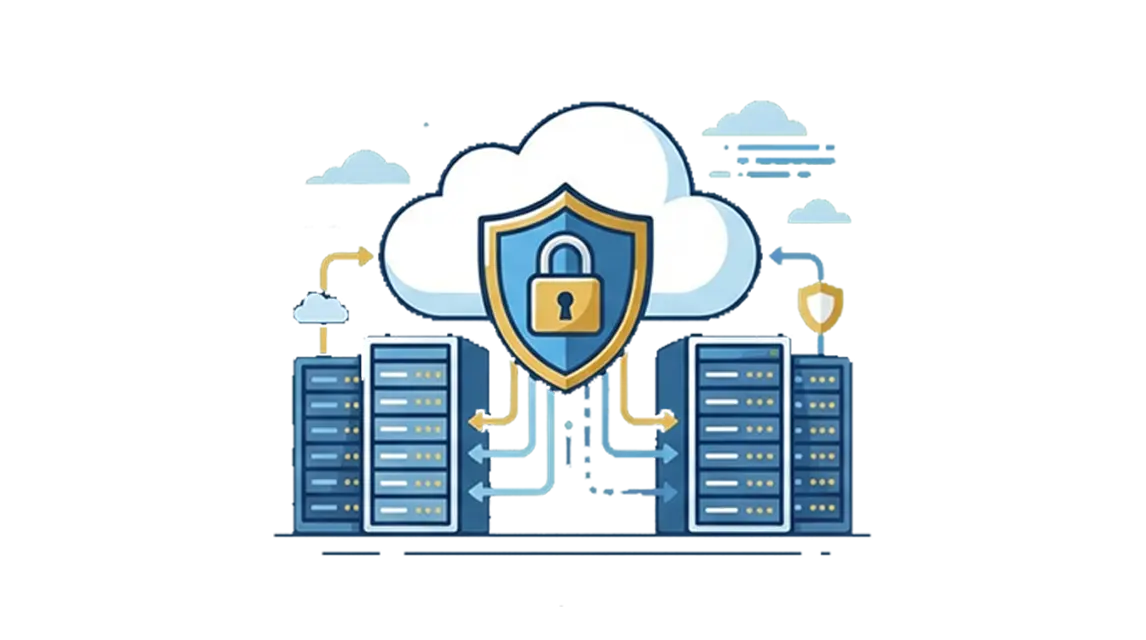
Why Are Cloud Servers More Secure?
Sometimes the question sounds like this: “Should I move to the Cloud or keep my own server?” In reality, the issue is not “where you store it,” but “how you protect it.” Cloud can be more secure, but only under one condition: you configure it according to proper server principles. ✅
In this article, we will explain why the Cloud environment is considered more secure, where risks increase, and which details are important when choosing a secure cloud server.

Main Advantages of Cloud Server Security
Physical security: from an office room to a data center
Traditional server rooms are often built “as best as possible.” Data centers, however, manage security as a system: access control, 24/7 security, surveillance cameras, fire protection, power redundancy, and climate control. For small businesses, creating this level internally is either very expensive or unrealistic.
Updates and patches: when delayed, risk grows
In on-prem environments, updates are often postponed: “so work does not stop,” “there is no time,” “we’ll do it later.” In the cloud server ecosystem, update mechanisms at the infrastructure level are more standardized. As a result, the probability that critical vulnerabilities remain open for a long time decreases.
Monitoring and incident response: “seeing” is half of security
Security is not only about “locking the door,” but also about understanding what is happening. On the Cloud side, logging, alerts, detection of suspicious activity, and rule-based automatic blocking are easier to implement. Most importantly, these tools are not an extra luxury, but a foundational part of a secure cloud server approach. 🔒
Backup and recovery: the “plan” must work on a critical day
Everyone talks about backup, but few test recovery. In cloud server environments, backup, versioning, and recovery scenarios are configured more flexibly. This increases resilience against ransomware risk and reduces business downtime in case of an incident.
Scalability: not losing control as you grow
As the business grows, servers, services, and users increase. In traditional environments, every new component is an additional risk. In the Cloud, network segmentation, role/permission management, and policies can be managed more systematically. This helps scale security together with growth.
Why Does Cloud Often Appear More Secure?
The reason is resources and focus. Large providers allocate dedicated teams, processes, and budgets to security. In small businesses, the same person may handle the network and answer the question, “why did the server slow down?”
This difference does not mean that on-prem is always weak. It simply means that maintaining the same level internally requires discipline and expertise. For many businesses, a cloud server helps reduce this burden.
The Biggest “But”: Cloud Is Not Automatic Security
The most common mistake is this: “we moved to the cloud, so we are secure.” No. In the Cloud, responsibility is shared: the provider protects the infrastructure, while you manage configuration, access, and data protection.
Incorrect configuration hits in three places ⚠️ - Ports and firewall rules remain excessively open. - User permissions are inflated (everyone is admin). - Encryption and backup scenarios are left incomplete.
So the problem is not the Cloud itself, but the lack of IT discipline.
A Short Checklist for a Secure Cloud Server
These steps may look small, but the result is significant:
Enable MFA and minimize admin access.
Apply least privilege: give everyone only the permissions required for their job.
Segment the network: keep critical systems in a separate segment.
Define encryption and key management plans in advance.
Perform a backup + recovery test: if recovery does not work, the backup “does not exist.”
These five steps elevate a Cloud server from “just a server” to a “proper server.” ✅

What Should You Consider When Choosing Cloud in Azerbaijan?
Cloud usage in Azerbaijan is increasing: flexible cost models and rapid scalability are driving this growth. Since precise market share statistics are not always publicly available, tying the decision more to business needs than to statistics is a healthier approach.
Especially for businesses working with finance, healthcare, and customer data, it is important to clarify in advance where the data is stored, who has access to it, and how audit trails are maintained. If you are unsure, it is more comfortable to start with less critical services as a pilot rather than with the most critical systems.
A practical approach: if internet stability is risky, consider a hybrid scenario; include SLA, data storage, and data export (exit plan) clauses in the contract; test the real level of technical support in advance; configure audit and log retention policies from the start.
Cloud servers are in many cases more secure because protection layers are more systematic, monitoring is more continuous, and recovery scenarios are more accessible. But this advantage works only when properly configured.
If you want to reduce risks, plan the move to the Cloud not as a “migration task,” but as a security project: tighten permissions, activate encryption, and обязательно conduct recovery testing. These three steps can prevent a major problem tomorrow. 🔒